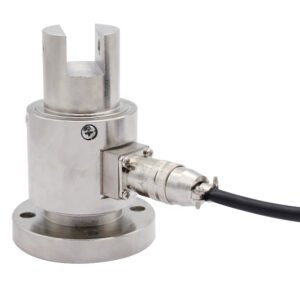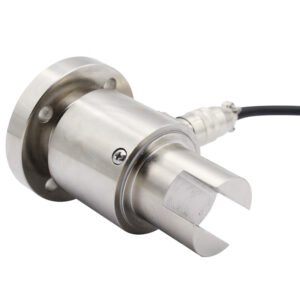

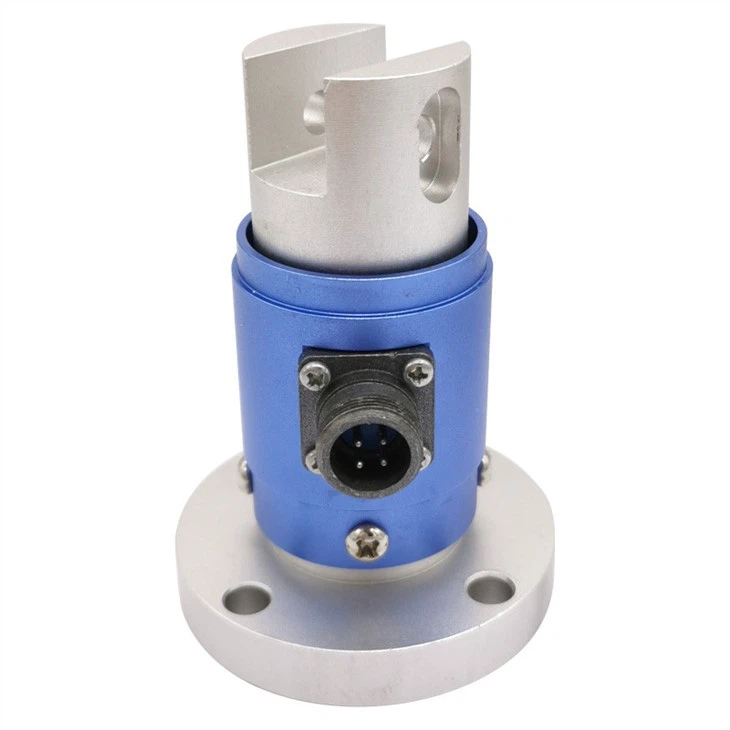
BRG611A Rotating Torque Sensor
Introduction
1. The resistance strain is a sensitive element, with high precision, stable and reliable performance.
2. Low-range torque measurement, easy to install and use.
3. One end is key (through groove) connection, and one end is flange connection.
4. Suitable for static torque measurement.

Technical Parameters
| parameter | Technical index | parameter | Technical index | |
| range | 0.5, 1, 2, 5, 10, 20, 30, 50, 100Nm | Response frequency | 100μS | |
| Sensitivity | 1.5±10% mV / V | Insulation resistance | ≥5000MΩ/ 100VDC | |
| Zero output | ±1% F.S. | Excitation voltage | 10VDC(9-15VDC) | |
| Non-linear | ±0.1, 0.3% F.S. | Temperature compensation range | -10 ~ 60℃ | |
| Hysteresis | ≤±0.05% F.S. | working temperature | -20 ~ 65℃ | |
| Repeatability | ≤±0.05% F.S | Safety overload | 150% F.S. | |
| Creep | ≤±0.03% F.S/30min | Extreme overload | 200% F.S. | |
| Temperature sensitivity drift | 0.03% F.S. / 10℃ | Cable size | Ø5.2×3m | |
| Zero temperature drift | 0.03% F.S. / 10℃ | Electrical connections | red/E+, black/E-, green/S+, white/S- | |
| Input resistance | 350, 750±10Ω | Material | Aluminum, stainless steel or alloy steel | |
| output resistance | 350, 700±5Ω | other request | customizable |
Dimension (mm)


1. Torque measurement; energy and signal non-contact transmission; output signal digitized.
2. High testing precision, high stability and anti-inter ference ability.
3. Repeating zero setting is not required continuous
4. Both static torque and dynamic torque can be measured.
5. An be used independently without secondary instrument, output signal can directly use by PLC or PC.
6. Can be customized according to customer requirements.
Application
Rotary torque sensors are used for strain measurement, testing of clutch and gearboxes, and dynamic torque within the engine. Additionally, powertrain, brake, and suspension systems are tested using torque sensors, which are also used to measure horsepower in the interest of improving fuel efficiency.