


Honeywell / Model 3663 / Seat Belt Load Cell
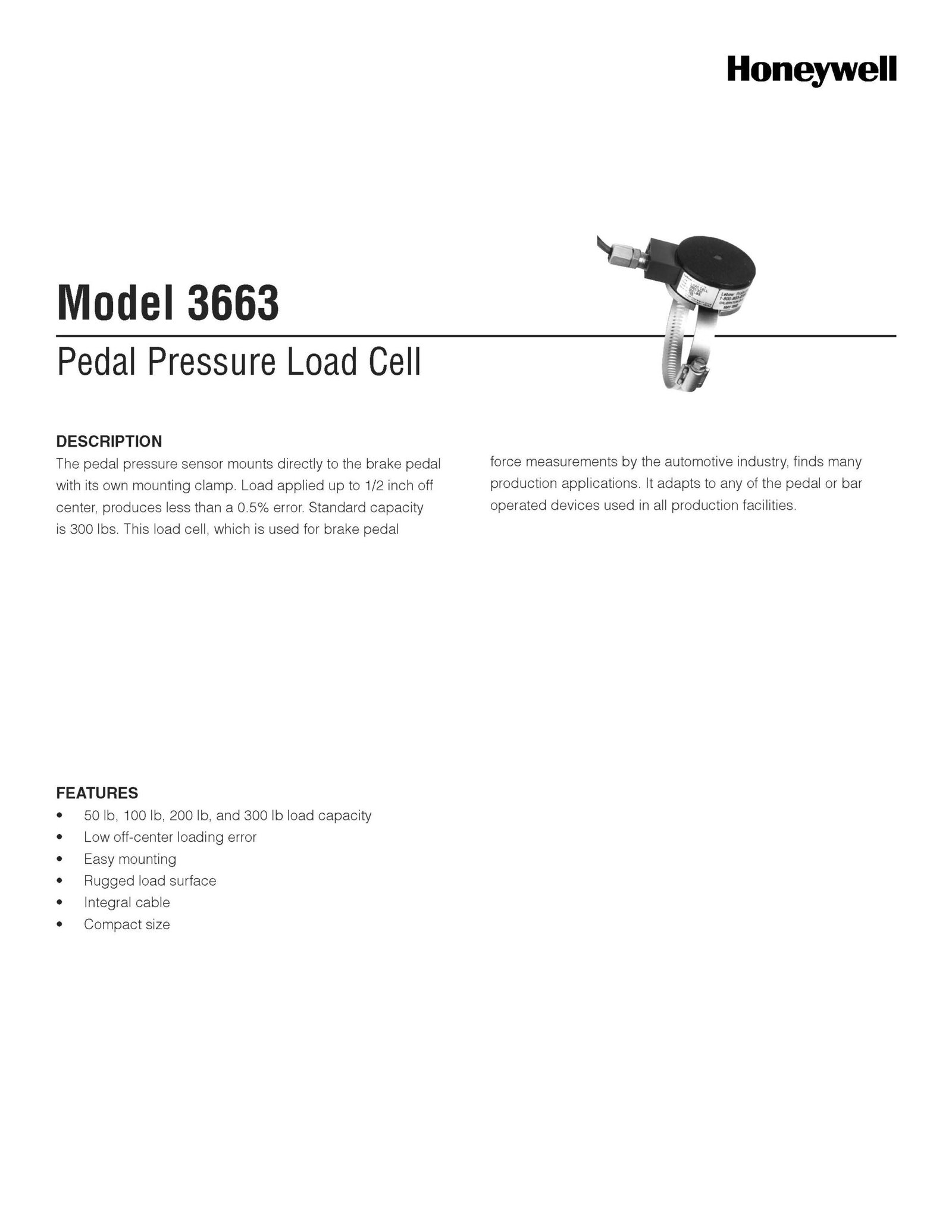
The pedal pressure sensor mounts directly to the brake pedal with its own mounting clamp. Load applied up to 1/2 inch off center, produces less than a 0.5% error. Standard capacity is 300 lbs. This load cell, which is used for brake pedal force measurements by the automotive industry, finds many production applications. It adapts to any of the pedal or bar operated devices used in all production facilities.

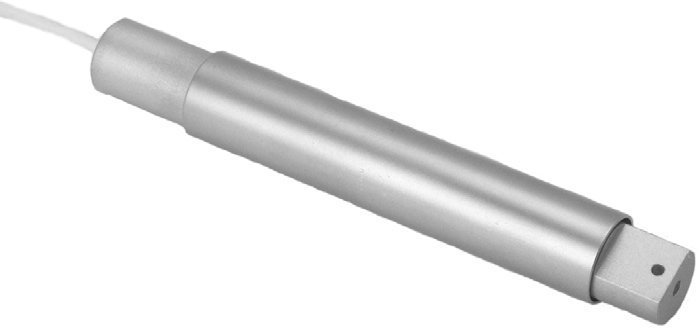
Models MBL Minigram Beam Load Cells are engineered to measure very low bending forces and still achieve an impressive 0.1 % full scale non-linearity and hysteresis. Built-in overload stops are incorporated to provide additional reliability. Miniature dimensions allow easy unit integration into existing systems. Model MBL uses semiconductor gages and is available for load ranges from 25 to 1000 grams.

The small-diameter, cost-efficient load cells are designed to be used in applications that require an ability to mount in an existing system with restricted working area. They are commonly used in fluid power transfer systems. Their low cost and ease of mounting allow simultaneous testing of multi-element systems.
They may be directly attached to the piston rod of a hydraulic cylinder. Side-mounted cable connectors allow cable assemblies to be supported without affecting movement of the cell during tension or compression loading.

The compact Model MPB Load Cells are designed for applications requiring high capacity yet where space restrictions require that the cell be small in size. The Model MPB will measure compression load forces in ranges between 15,000 to 2,000,000 pounds.
Applications include impact testing and mine shaft roof simulations. The diameter of these load cells range between 1.25 in and 10 in while the height ranges between approximately 0.63 in and 14 in depending on the load range desired.

Model AL-JP is a high output load cell (30 mV/V minimum). These semiconductor strain gage load cells are engineered to measure loads from 500 lb to 2000 lb. The tension/compression Model AL-JP is designed with female threads. It provides high performance in non-linearity, hysteresis, and repeatability. Low mechanical deflection allows for better response capability.

Model RF, with female threads, is a high output rod end load cell designed to be mounted inline to the load axis to measure tension. The outputs for these load cells are ±5 Vdc or 10 Vdc, or
4 mA to 20 mA (two wire) all calibrated in tension. The mounting thread configurations and the all welded stainless steel construction make these tension load cells ideal for a variety of rugged field applications as well as in the laboratory.
The optional high output signal offers resistance to electrical noise as well as additional signal resolution. Additional options include an internal buffered shunt calibration circuit for ease of setup with an associated indicator, and a variety of thread selections, including metric sizes.
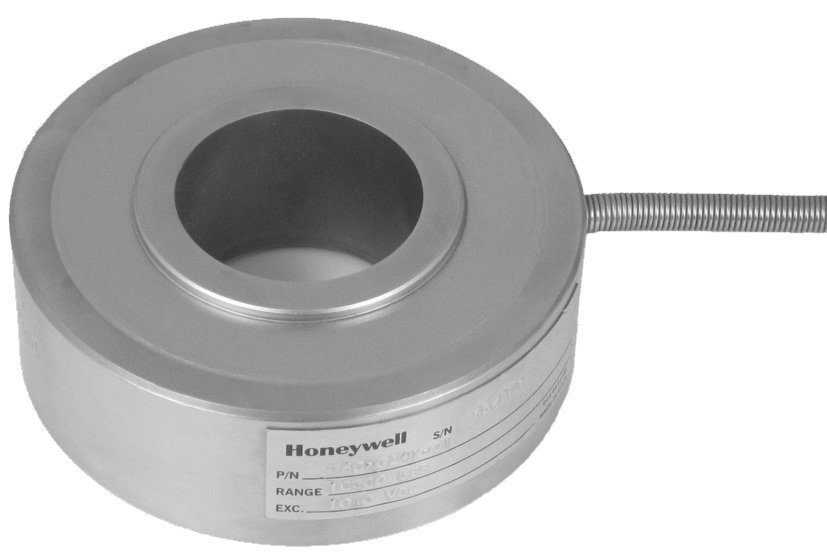
The Model D Donut Shaped Load Cell features a smooth thru-hole design often ideal for applications which require the load structure to pass directly through the cell. Such applications include bolt force measurements, clamping forces, and monitoring overloads. Load ranges as low as 150 grams and as great as 30,000 pounds can be measured within a maximum full scale non-linearity and hysteresis of ±0.5 % F.S., respectively. These models are used in compression applications and are available in multiple hole and frame sizes. For optimum performance, these cells must be mounted between load surfaces which are flat and parallel. The Model D miniature load cell is designed to have a minimum thickness.

Model AL-SC is high-output load cell. These semiconductor strain gage load cells are engineered to measure loads from 500 lb to 2000 lb. The tension/compression Model AL-SC is designed with female threads. It provides high performance in non-linearity, hysteresis, and repeatability. Low mechanical deflection allows for better response capability.

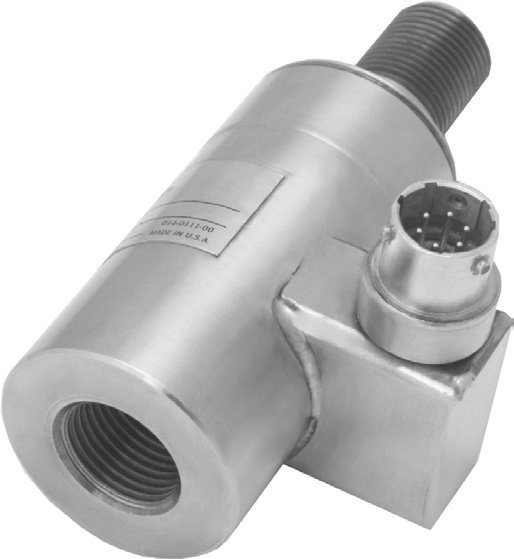
Model RH, with male and female threads, is a high output rod end load cell designed to be mounted inline to the load axis to measure tension. The outputs for these load cells are ±5 Vdc or 10 Vdc, or 4 mA to 20 mA (two wire) all calibrated in tension. The mounting thread configurations and the all welded stainless steel construction make these tension load cells ideal for a variety of rugged field applications as well as in the laboratory.
The optional high output signal offers resistance to electrical noise as well as additional signal resolution. Additional options include an internal buffered shunt calibration circuit for ease of setup with an associated indicator, and a variety of thread selections, including metric sizes.

The Model LC digital force indicator is a highly portable force measurement device. With its 9 V battery supply and compact size the indicator can easily be carried to remote locations to perform force measurement calibrations. The unit can measure compression forces up to 50,000 lbs.
The peak capture feature allows the highest force reading taken to be displayed with the push of a button. The remote location of the load sensor minimizes the chance of damage to the electronic body of the gauge. The stainless steel construction of the sensor and the indicator makes them often resistant to the occasional mishandling than can occur in the field. Optional handles are available for the load cell and gauge.
Each unit has a membrane face with raised buttons and tactile feedback for setup and operation. The high, low, and clear buttons are easily accessible on this front membrane. Zero adjustment and zero offset/tare functions are standard on each unit. Calibration and setup parameters are stored on a memory chip to protect from loss even when power is interrupted. Unauthorized set ups and calibrations are also blocked with internal security. Various combinations of the front panel buttons can be de-activated.
