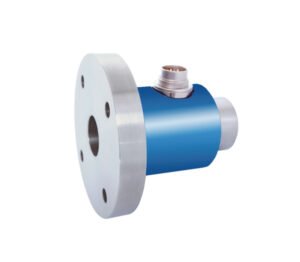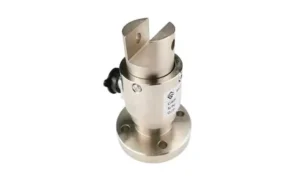
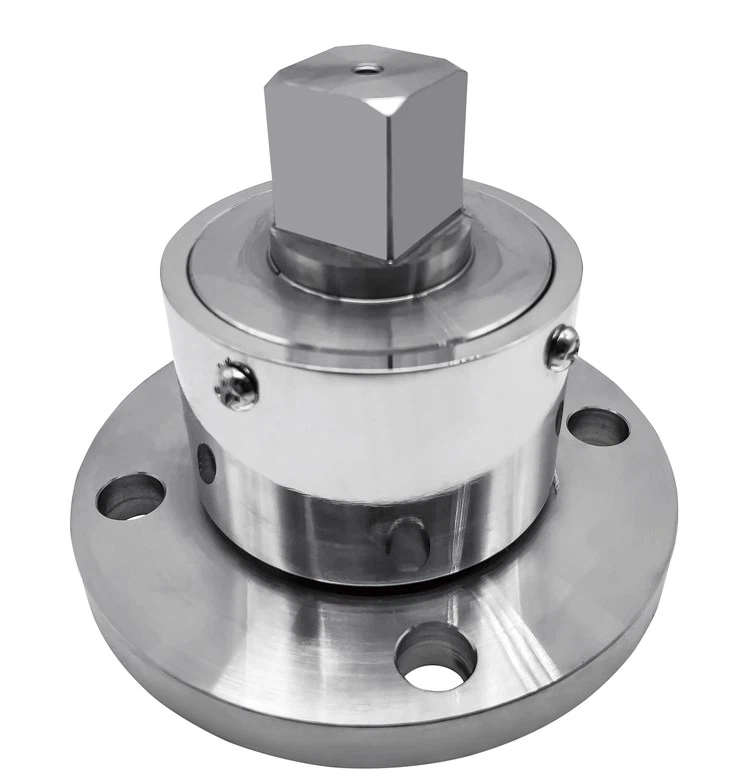
ZNJ-103 Static Torque Transducer For Mechanic Protection
Static Torque Transducer for Industrial Calibration
Model: ZNJ-103
A static torque sensor, also known as a reaction torque sensor, measures the twisting force on a non-rotating object or in a steady, slow-moving system. They are designed to measure the reaction torque, the twisting force generated against a fixed support, without measuring continuous rotation. These sensors are highly valued for their stability, precision, and durability.
How a static torque sensor works
Static torque sensors typically operate using strain gauge technology. The process works in a step-by-step manner:
1. The sensor is attached to a component or shaft where torque measurement is required.
2. When torque is applied, the internal elastic element of the sensor undergoes a slight mechanical deformation or twist.
3. Strain gauges, which are electrical resistors bonded to the elastic element, also deform. This deformation causes a change in their electrical resistance proportional to the applied torque.
4. A Wheatstone bridge circuit converts the resistance change into an electrical signal, typically a voltage.
5. This electrical signal is then amplified, processed, and translated into a precise torque reading.

◆ Dimensions:

| Capacity Range (N.m) | VK | A | B | C | D |
| 5-15 | 1/4″ | 52.5 | 10.5 | 7.5 | 8.5 |
| 20 – 50 | 3/8″ | 56 | 14 | 11 | 12.8 |
| 100 | 1/2″ | 60 | 18 | 15 | 17 |
| 200-500 | 3/4″ | 80 | 28 | 23 | 26 |
| 1000 | 1″ | 85 | 33 | 28 | 34 |
◆ Features and Applications
◆ Technical parameter
| Parameters | Specification |
| Capacity | 0~20,50,100,200,300,500Nm |
| Rated Output | 1.5+10% mV/V |
| Zero Balance | ±1%FS |
| Non Linearity | +0.1-0.3%FS |
| Hysteresis | ±0.05%F.S |
| Rapeatability | 0.05%F.S |
| Creep | 0.03%F.S/30min |
| Tamp Effact On Output | 0.03%F.S/10℃ |
| Temp Effect On Zero | 0.03%FS/10℃ |
| lnput impedance | 350/750±10Ω |
| Output impedance | 350/700±50Ω |
| Raspones Fraquency | 100μS |
| Insulation | ≥5000MΩ/100V |
| Recommended Excitation | 10V(DC) |
| Compensated Temp Range | -10 ~ 60℃ |
| Operation Temp Range | -20 ~ 65℃ |
| Safe Overload | 150%F.S |
| Ultimate Overload | 200%F.S |
| Cable Size | φ5.2 x 3 m |
| Cable Color Code | Input Red( +), Black(-)Output Green(+), white(-) |
| Material | Stainless steel/Alloy steel |