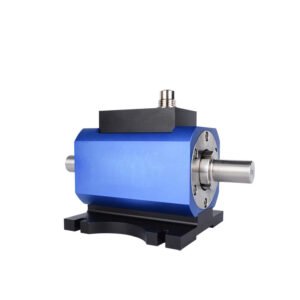
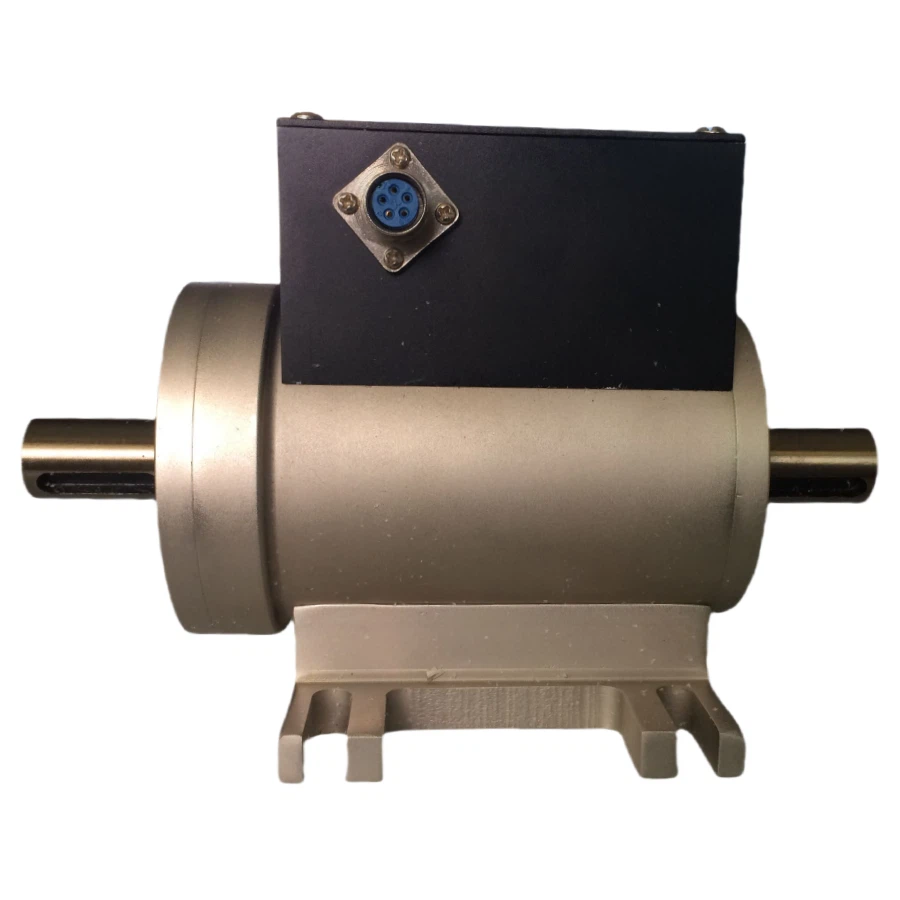
BRG-803 Non Contact Torque Sensor
BRG-803 Non Contact Torque Sensor
1. Capable of measuring both static and rotating torque;
2. Strong anti-interference performance, high accuracy, and excellent stability;
3. Digital output signal, compact size, and wide range;
4. Easy to install, with contactless power and signal transmission;
5. Signal transmission is independent of rotation, speed, or direction;
6. Continuous transmission of positive and negative torque signals without repeated zeroing;
7. No wear parts such as slip rings, allowing for long-term high-speed operation;
8. No bearings between the housing and the rotating disk, capable of long-term high-speed operation, capable of transmitting static, rotating, static, and dynamic torque signals.

Technical Parameters
| Range | 5,10,20,30,50,100-100kNm |
| Accuracy | ±0.1,±0.2%FS |
| Zero Temperature Effect | ±0.02%FS |
| Span Temperature Effect | ±0.02%FS |
| Compensated Temperature Range | -10~60ºC |
| Operating Temperature Range | -20~75ºC |
| Torque Output | 10±5kHz (Amplitude12V,midnight 10kHz)
4-20mA, ±5VDC,±10VDC,RS485, RS232,CAN, |
| Supply Voltage | ±15V DC (for frequency signal output), 24V DC (for voltage or current signal output) |
| Supply Current | Less than 100mA |
| Electrical Connections | 5-Pin |
| Overload Protection | 200%FS |
| Material | Shaft material 17-4PH stainless steel, housing is aluminum |
| Speed Measurement | Speed measurement:speed:0-1000,3000,6000,8000RPM,
60/30pulse, 4-20mA,5V/TTL ,±5VDC, ±10VDC,RS485,RS232, CAN |
Dimension (mm)

| CAP(Nm) | d | D | A | B | C | E | F | G | H | h | C1 | E2 | L | key |
| 5-100 | 18 | 78 | 8 | 72 | 122 | 31 | 61 | 100 | 116 | 54 | 90 | 50 | 188 | 6*6*25*1 |
| 200 | 28 | 92 | 8 | 72 | 123 | 41 | 61 | 100 | 125 | 60 | 90 | 59 | 209 | 8*7*35*1 |
| 300-500 | 38 | 96 | 12 | 72 | 124 | 55 | 61 | 100 | 135 | 65 | 90 | 74 | 238 | 10*8*50*2 |
| 1k-2k | 48 | 106 | 12 | 69 | 126 | 70 | 78 | 120 | 144 | 68 | 90 | 90 | 270 | 14*9*65*2 |
| 3k | 55 | 118 | 12 | 65 | 127 | 88 | 115 | 155 | 170 | 77 | 90 | 123 | 311 | 16*10*80*2 |
| 5k | 75 | 144 | 14 | 69 | 131 | 105 | 156 | 180 | 185 | 90 | 100 | 139 | 347 | 20*12*95*2 |
| 10k | 98 | 158 | 14 | 80 | 143 | 118 | 170 | 200 | 214 | 110 | 110 | 155 | 389 | 28*16*115*2 |
| 20k-30k | 105 | 170 | 14 | 87 | 160 | 125 | 180 | 204 | 236 | 115 | 123 | 165 | 420 | 28*16*119*2 |
| 50k-60k | 150 | 240 | 14 | 89 | 163 | 123 | 184 | 230 | 309 | 153 | 123 | 165 | 419 | 40*22*115*2 |
| 100k | 170 | 270 | 16 | 95 | 188 | 200 | 194 | 240 | 340 | 169 | 140 | 252 | 598 | 45*25*195*2 |
Application Scenario Display
Controlling Torque Output
Connect a torque sensor between the load and the motor to monitor the output torque in real time.


Detects motor torque, speed, power, etc.
Based on the output standard torque and speed signal, the motor under test can be measured.
Engine Characteristic Testing
For various engine tests, key parameters such as torque, speed, and power can be measured.


Conveyor Abnormality Detection
During conveyor operation, torque measurement of the conveyor’s rotating shaft can monitor engagement anomalies, quickly detect foreign objects and fallen workpieces, and halt conveyance.
Mixers
The load torque applied to the impeller shaft during mixing can be measured. Fluctuations in the mixing torque can be used to understand viscosity fluctuations caused by mixing and reaction operations in chemical processes. Using a torque sensor, signals can be output based on the upper and lower torque limits.

Measuring Power Generation Efficiency
The power generation efficiency of wind turbines and other equipment can be measured. A sensor inserted into the rotating shaft calculates torque and rotational speed, and then compares these with the actual power generation to determine the power generation efficiency.


Measuring Power Generation Efficiency
The load fluctuations of paper, foil, and sheet materials passing through conveyor rollers can be measured. By measuring torque, the width can be adjusted and quantitatively managed.
Steering Inspection
We conduct shipment inspections by measuring the torque and rotation of automotive components such as steering.