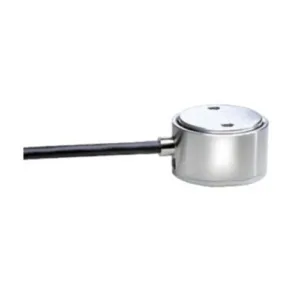
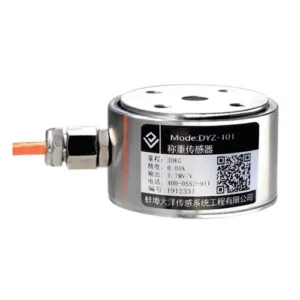
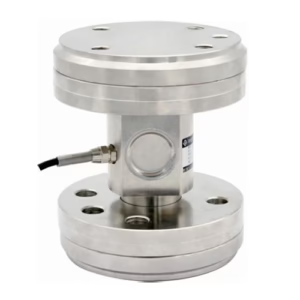
ATO-LCC-DYMH-103 Tension and Compression Load Cell, 1 kg – 500 kg
After purchasing one ATO load cell, you can buy a special digital panel meter to obtain readings directly, or buy a transmitter to output standard signal to PLC, DCS and other systems. Customized output signal is 0-5V, 0-10V, or 4-20mA.
Note: The load cell cannot be connected to both the transmitter and the controller at the same time — only one can be selected.
Tension and compression load cells have capacity range from 1kg, 5kg, 20kg, 30kg, 100kg, 200kg, 250kg, 300kg to 500kg. Load cell capacity can be customized according to customer requirements.
Specification
| Model | ATO-LCC-DYMH-103 |
| Weight | 0.1kg |
| Capacity Range * | 0kg~500kg |
| Matched Display Controller | ATO-DDC5-CHB (Click it to the controller page) |
| Matched Transmitter | ATO-LCTR-OA (Click it to the transmitter page) |
| Accuracy | 0.3%F.S (linearity + hysteresis + repeatability) |
| Sensitivity | 1.0~1.5mV/V (Low range variations may differ) |
| Creep | ±0.05%F.S/30min |
| Zero Output | ±1%F.S |
| Temperature Effect on Zero | ±0.05%F.S/10℃ |
| Temperature Effect on Output | ±0.05%F.S/10℃ |
| Operating Temperature | -30℃~+70℃ |
| Input Impedance | 400±10Ω |
| Output Impedance | 350±10Ω |
| Insulation Resistance | ≥5000MΩ |
| Safety Overload | 150%F.S |
| Overload Limit | 200%F.S |
| Bridge Voltage (excitation voltage) | DC 5-15V, suggest DC 10V |
| Material | Stainless steel |
| Protection Class | IP67 |
| Cable Length | 2m |
| Wiring | EXC+: Red, EXC-: Black, SIG+: Green, SIG-: White |
Feature

- High-Quality 17-4PH Stainless Steel: Resistant to fatigue and corrosion, offering exceptional strength and durability.
- High Temperature Resistance: Ideal for high-temperature environments, with excellent heat resistance.
- Compact and Lightweight: Small size and low-profile design provide high resistance to offset errors.
- Versatile Application: Suitable for automotive assembly, automation, medical testing, industrial testing, and more.
- Long-Term Stability: Designed for extended use without wear, ensuring stable performance over time.
- Efficient and Reliable: Low hysteresis and excellent long-term stability even under fluctuating temperatures.
- Wide Measurement Range: Capable of measuring a wide range of forces with minimal distortion.
Dimension (unit: mm)
| Capacity | M |
| 1kg, 5kg, 10kg, 15kg, 20kg, 30kg, 50kg | M5*0.8 |
| 60kg, 100kg | M6*1.0 |
| 150kg, 200kg, 250kg, 300kg, 400kg, 500kg | M8*1.25 |
Lead wire=1500mm, screw thread length=8mm

Application

Tips: How do I calibrate the Tension and Compression Load Cell?
Calibration of the Tension and Compression Load Cell is a critical step to ensure that it provides accurate measurements over time. Here’s a detailed guide on how to calibrate the load cell:
- Zero the Load Cell: Before calibration, make sure that the load cell is not under any load, and that the signal is reset to zero. This step eliminates any offset errors.
- Apply Known Weights: Use calibrated test weights or forces that are close to the load cell’s rated capacity. These known weights will serve as references during calibration.
- Record the Output: For each known weight applied, record the load cell’s output signal (e.g., voltage or current). This will help establish a relationship between the applied load and the output signal.
- Adjust the Output Signal: Using the calibration equipment or software, adjust the load cell’s output signal so that it matches the applied weight. This step aligns the system with the known values.
- Verify Calibration: After completing the calibration, apply different known weights (spanning the load cell’s range) and check that the output signal matches the expected values. This helps verify that the calibration is accurate.