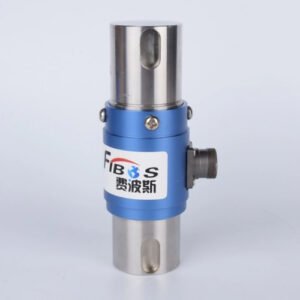
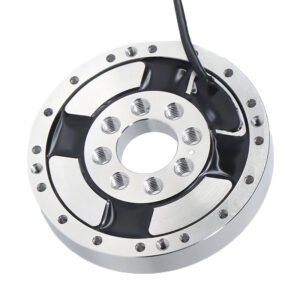
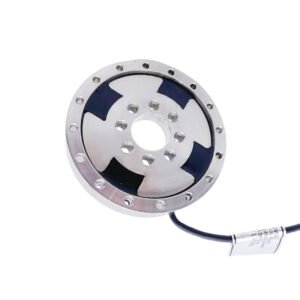
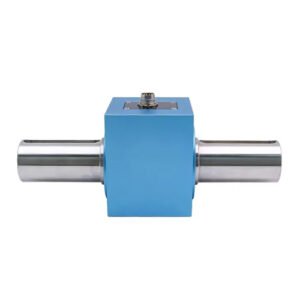
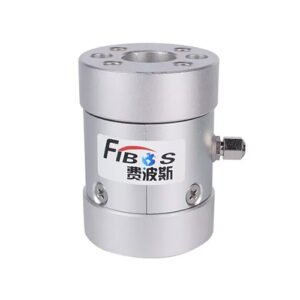
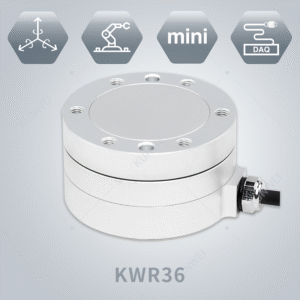
KWR75EC 75mm 6 Axis Force Strain Gauge Sensor Built in UDP TCP
Description

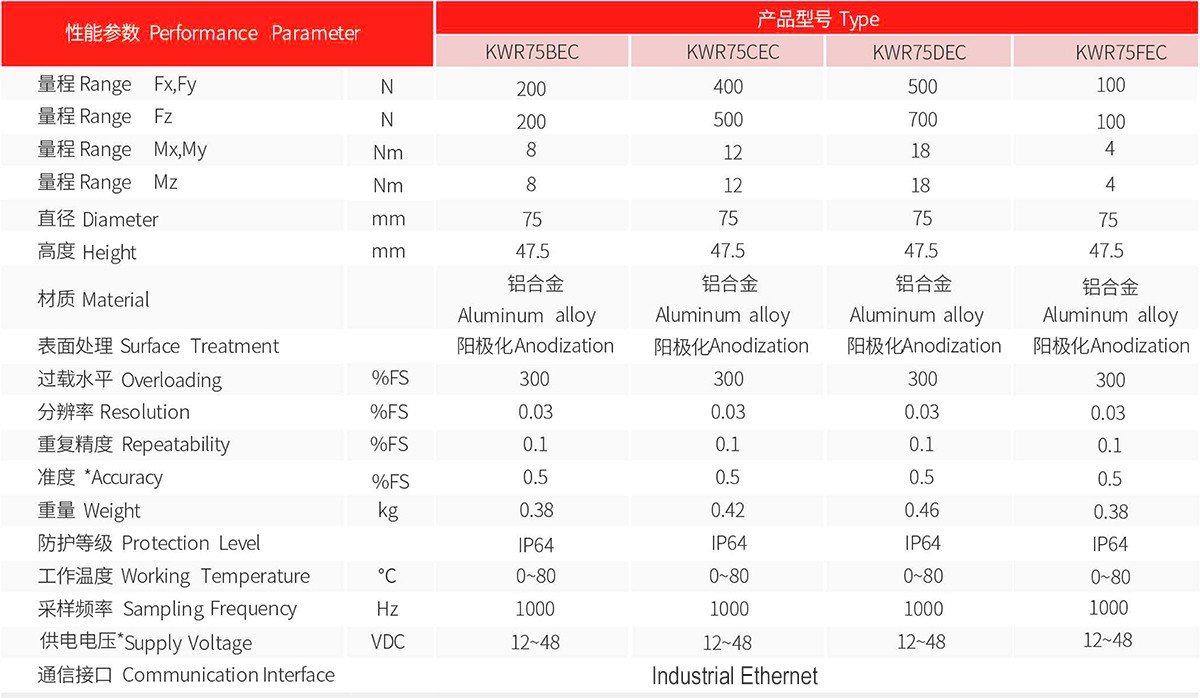
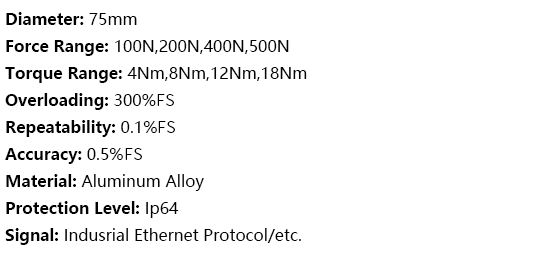
KWR75EC series is a muti-axis load cell customized according to customer needs. The product itself is output in the form of industrial Ethernet by default, and meets the needs of various industrial application scenarios. It is made of high strength aluminum alloy, which can withstand harsh production and test environments. The surface anodizing polishing process can protect the sensor from corrosion. And the sensor could realize various forms of internal outlet or side outlet according to customer requirements. The transducer greatly suppress the crosstalk between the components, collect and perform real-time particular algorithms in real time, the repeatability precision of the sensor is 0.1%FS and the accuracy is 0.5%FS.
What is repeatability precision ?
The evaluation index of the consistency between multiple repeated measurements, that is the consistency of the output results obtained when the sensor repeatedly measures a certain same loading group(the combination of three direction force and three direction torque). Repeatability precision is the percentage of standard deviation of output error than rated output(%FS).
What is the accuracy?
The evaluation index of deviation between measured value and real value. Accuracy is the percentage of standard deviation between output and theoretical true value than rated output(%FS).
How Force and Torque Sensors Work?
there are several mechanisms by which forces are converted to electrical signal, the main parts of a force and torque sensor are the same. Two outer frames, typically made of aluminum or steel, carry the mounting points, typically threaded holes. All axes of measured force can be measured as one frame acting on the other. The frames enclose the sensor mechanisms and any onboard logic for signal encoding.
The most common mechanism in six-axis sensors is the strain gauge. Strain gauges consist of a thin conductor, typically metal foil, arranged in a specific pattern on a flexible substrate. Due to the properties of electrical resistance, applied mechanical stress deforms the conductor, making it longer and thinner. The resulting change in electrical resistance can be measured. These delicate mechanisms can be easily damaged by overloading, as the deformation of the conductor can exceed the elasticity of the material and cause it to break or become permanently deformed, destroying the calibration. However, this risk is typically protected by the design of the sensor device. While the ductility of metal foils once made them the standard material for strain gauges, p-doped silicon has proven to show a much higher signal-to-noise ratio. For this reason, semiconductor strain gauges are becoming more popular. (Becuase KUNWEI’s great materials and Exquisite production technology, our overloading around 300% )

Model of KWR75EC