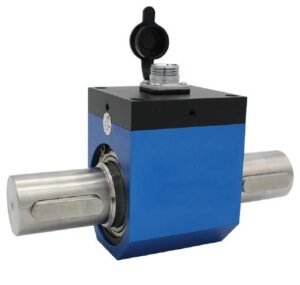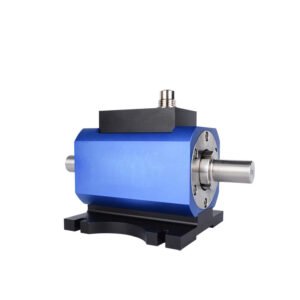
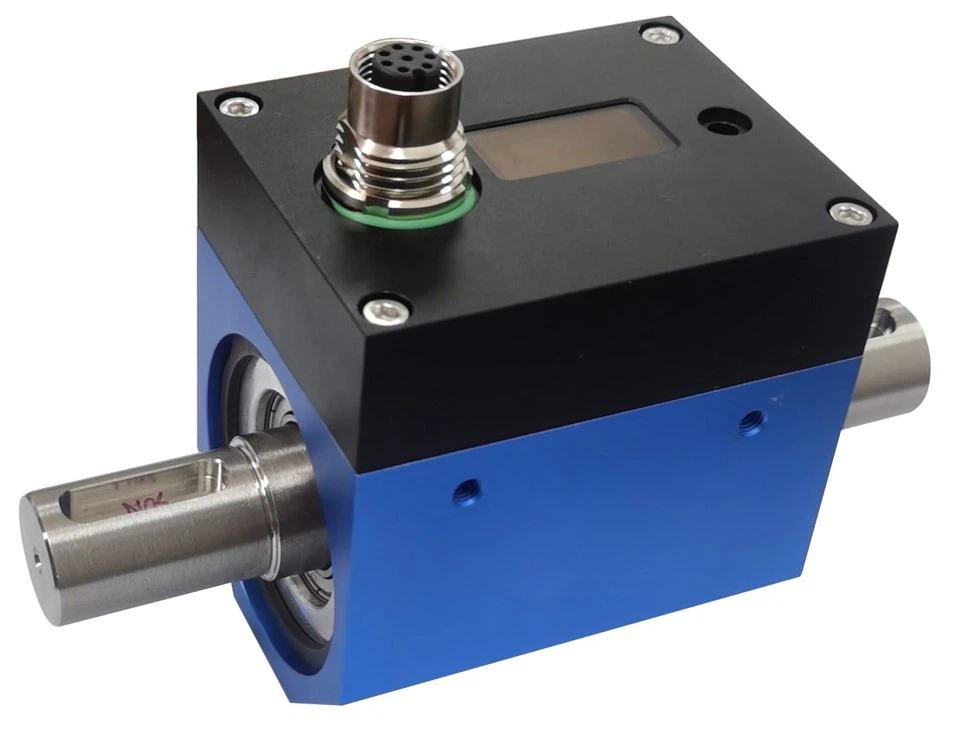
BRG-62050A Non Contact Torque Meter
Features :
- High measurement accuracy up to ±0.25% FS, with fine resolution of approximately 0.02%.
- Fast frequency response, suitable for both static and dynamic torque measurement.
- Capable of measuring torque in both forward and reverse directions.
- Long service life and high reliability, requiring minimal maintenance.
- Strong anti-interference performance, ensuring stable signals in complex environments.
- Ideal for high-speed operation and applications with frequent load changes.
- Minimal influence on shaft system stiffness and rotational inertia, preserving the original mechanical performance of the system.

Technical parameters
| Range :5,10,20,30,50,100,200-500Nm
Accuracy :±0.1,±0.2%FS
Zero point temperature influence :±0.02%FS
Full temperature effect :±0.02%FS
Compensated temperature range :-10~60ºC
Operating temperature range :-20~75ºC
Torque output: 10±5kHz ,4-20mA, ±5VDC,±10VDC,RS485, RS232,CAN,
Supply voltage :12-24VDC |
Supply current :less than 100mA
Electrical Connections :8-Pin
Overload protection :200%FS
Material : Shaft material 17-4PH stainless steel, housing is aluminum
Options
Speed measurement : Maximum speed :15000RPM,60 pulse , 4-20mA,5V/ TTL ,±5VDC, ±10VDC,RS485,RS232, CAN |
Dimension (mm)
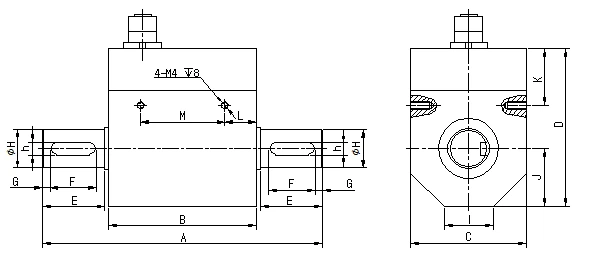
| Model | Range | A | B | C | D | E | F | G | H | h | I | J | K | L | M |
| 62050A | 5,10,20,30,50,100 | 133 | 70 | 55 | 75 | 30 | 22 | 3.5 | 18 | 6 | 23 | 27.5 | 27 | 15 | 40 |
| 62050B | 200,300,500 | 144 | 70 | 65 | 85 | 35 | 30 | 3 | 28 | 8 | 29 | 32.5 | 28 | 12 | 46 |
why choose our non contact torque meter

High-quality waterproof aviation connector ensures high-speed and stable signal transmission
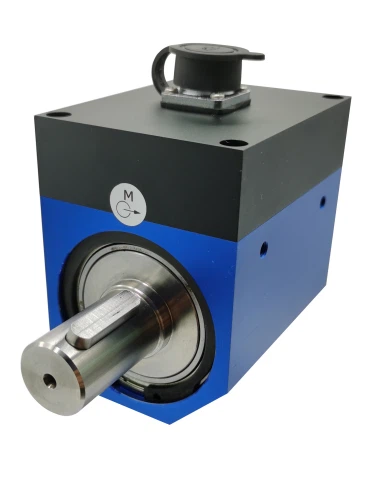
Strong anti-interference capability, high detection accuracy, and stable and reliable performance

Premium 17-4 stainless steel elastomer, high-speed milling and turning, one-piece molding
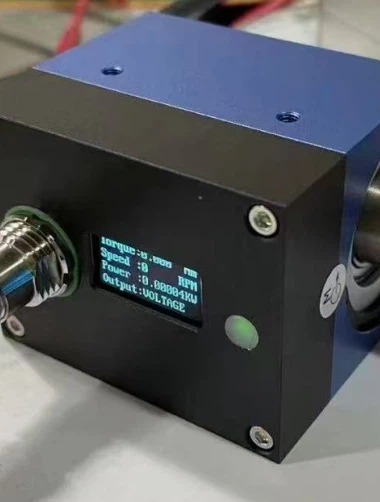
Can be equipped with a display screen for easy viewing of data, torque, and speed
High Precision and Stability
High detection accuracy, good stability, and strong anti-interference capability;


High quality Bearings
Uses imported NSK bearings for more accurate measurements, high load capacity, smooth operation, and durability;
Compatible with Transmitter and Display
- The sensor output supports connection to a transmitter for standard signal outputs.
- Compatible with signal transmitters for multiple standard output options.

Appliactions
Controlling Torque Output
The torque sensor is mounted between the motor and the load to continuously monitor the output torque.
Place the torque sensor between the motor and the load to achieve real-time torque monitoring.


Detects motor torque, speed, power, etc.
The motor under test can be measured using the standard torque and speed output signals.
Based on the standardized torque and speed signals, the performance of the motor under test can be assessed.
Engine Characteristic Testing
- For different engine tests, essential parameters like torque, speed, and power can be monitored.
- Across multiple engine testing applications, parameters such as torque, speed, and power can be measured.


Conveyor Abnormality Detection
- Measuring the torque of the conveyor shaft during operation helps identify engagement anomalies, quickly detect foreign objects or fallen workpieces, and stop the conveyor in time.
- Real-time torque monitoring of the conveyor’s rotating shaft allows abnormal engagement, obstructions, or dropped workpieces to be detected and the conveyor to be halted.
Mixers
- The load torque on the impeller shaft can be monitored during mixing. Changes in torque indicate viscosity variations arising from mixing and chemical reactions. A torque sensor can provide output signals when the torque reaches preset upper or lower limits.
- Measuring the torque of the impeller shaft during mixing helps identify viscosity changes caused by mixing and reaction operations. Using a torque sensor, signals can be output according to specified torque thresholds.


Measuring Power Generation Efficiency
- The power generation efficiency of wind turbines and other equipment can be measured by inserting a sensor into the rotating shaft to capture torque and speed, then comparing these with the actual power output.
- By mounting a sensor in the rotating shaft, torque and rotational speed are calculated and compared with the real power output to determine generation efficiency.
Measuring Power Generation Efficiency


Steering Inspection
- We perform shipment inspections by checking the torque and rotational performance of automotive components such as steering parts.
- Our shipment inspections involve measuring the torque and rotation of automotive components, including steering mechanisms.